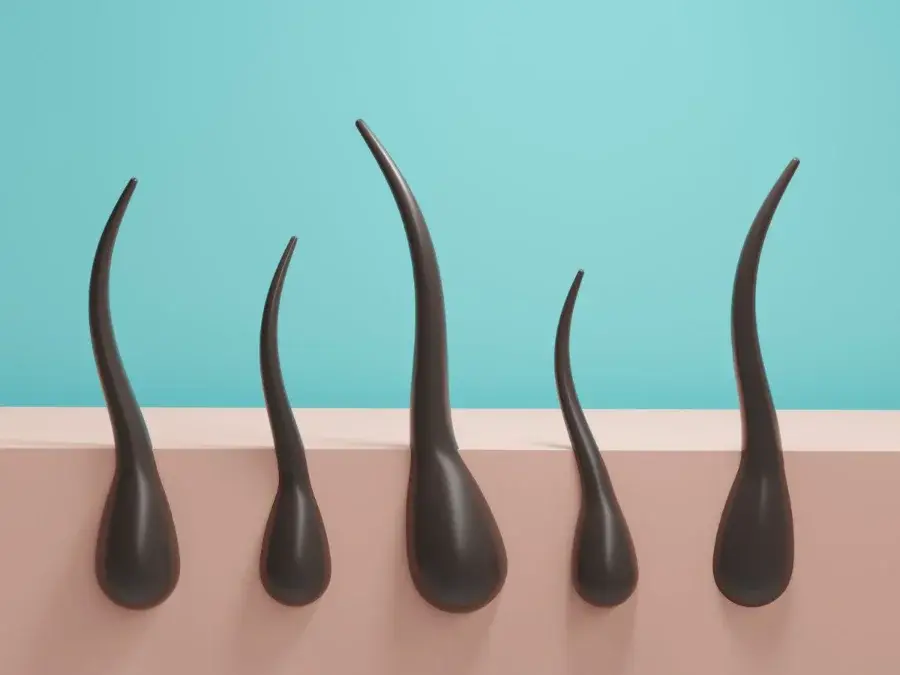
Unwanted hair growth refers to excessive hair, meaning more than what is considered normal for an individual's age, gender, and ethnicity.
Excessive Hair Growth
Hypertrichosis or Hirsutism
It is good to know the difference between hypertrichosis and hirsutism when discussing unwanted hair growth. Both conditions describe increased hair growth on the face, chin, abdomen, bikini area, and body in general.
However, in the first case, increased hair growth is observed in men and women, anywhere on the body, with a normal distribution for both sexes. In the second case, which only affects women, increased hair growth is found on the face or body, in areas where hair growth is normally characteristic of men.
Such androgen-dependent areas include:
- the upper lip
- the cheeks
- the breasts
- the lower abdomen
- the back
- the inner thighs
Read more...
Increased hair growth: When should I get a hormonal check?
“Hypertrichosis - hirsutism affects 5 to 10% of women of all ages”
Hair Growth in the Bikini Line
Where is the Bikini Line located?
Unwanted hair in the bikini area is a concern for women, especially as summer approaches.
The bikini line is the area of skin around the pubic region, which is covered by the lower part of a woman's swimsuit. This specific area varies depending on each woman's body type. Sometimes it may be smaller around the pubic bone, and other times it may cover a larger area.
Bikini Hair Removal
The effectiveness of laser hair removal is dependent on many factors, such as:
- Hair color.
- Skin color.
- The general condition of the skin, as it is important that there are no rashes, infections, or open wounds on the skin.
- Tanning, as it is best for the body to be in its natural skin tone.
As with any treatment, for laser hair removal, you will be informed about your medical history and any medication you may be taking that could affect the procedure. At the same time, you will be informed about the Alexandrite laser application process, preparation, the expected results for hair growth, and the instructions to follow after each session.
What to expect from Bikini Hair Removal?
Laser hair removal will require more than one session, typically 6 to 8, at intervals of 3 to 6 weeks, in order to achieve 80 to 90% hair reduction in the bikini line.
This is unavoidable to target hairs at a specific point in their growth cycle.
In the bikini area, a significant reduction and permanent hair removal are largely achieved, and it is not uncommon for maintenance treatments to be required once or twice a year.
A significant advantage, in addition to its permanent results, is the improved skin tone and texture, as the treatment leaves a permanently clean, smooth area. Furthermore, you will be free from the problems created by other hair removal methods, such as skin irritations and ingrown hairs.
Finally, you save time and money, as once the treatment is complete, you will no longer need to shave or wax for hair removal.
Hair on the Upper Lip
Excessive hair on the upper lip, as well as on the chest and back, is the growth of dark, thick hair in a male pattern, meaning in areas where men typically have it. The so-called “mustache” is strictly associated with a male image. In women, it becomes a source of anxiety, which is why laser hair removal is the best solution to permanently get rid of it and generally facial hair.
Read also...
Laser Hair Removal: Everything you need to know
Unwanted Hair Growth & Causes
Unwanted excessive hair growth can be associated with medical conditions such as:
- Polycystic Ovary Syndrome (PCOS), a condition that begins in adolescence and is a common cause of hirsutism. During Polycystic Ovary Syndrome, cysts form on the ovaries, which can affect hormone production.
- Adrenal gland dysfunction, such as congenital adrenal hyperplasia, Cushing's syndrome, and more rarely, tumors in the ovaries and adrenal glands.
- Certain medications, corticosteroids and anabolic steroids have also been linked to the development of excessive hair growth.
- Menopause, during which women are no longer under the influence of estrogens, and their hair growth increases.
"70-80% of women with Polycystic Ovary Syndrome experience hair growth"
Hair Growth & Risk Factors
Risk factors that can influence the appearance of excessive hair growth include:
- Family medical history. Women with a family history of polycystic ovaries or congenital adrenal hyperplasia are more likely to develop excessive facial hair.
- Origin, as women of Mediterranean and Middle Eastern descent often have more body hair compared to other women without a medical cause.
- Obesity, which is linked to increased androgen production, can worsen excessive hair growth.
Hair Growth & Diagnosis
The doctor can diagnose hirsutism with a clinical examination and a complete medical history. Additional blood tests or imaging tests may be necessary to identify the cause of excessive hair growth.
Diagnosing the cause of excessive hair growth is important because it will determine the subsequent treatment.
Hair Removal Treatment
The treatment for excessive hair growth involves two main approaches:
- Medical treatment, which addresses the underlying cause of excessive hair growth, with medication that may include contraceptives, antiandrogens, corticosteroids, etc.
- Aesthetic hair removal treatments, with laser hair removal being the most modern, featuring technology that continuously evolves and leads to permanent results for patients.
Alexandrite laser hair removal offers numerous advantages over traditional hair removal methods because:
- It improves skin texture.
- It saves time and avoids irritations caused by methods such as shaving.
- Skin tone becomes even.
- Your appearance and self-confidence improve.
Often, the two aforementioned treatment methods are combined to achieve the best possible outcome.
Unwanted hair growth itself does not affect physical health. However, it can cause anxiety about one's appearance and affect your mental well-being.
Can excessive hair growth be prevented?
Excessive hair growth cannot be prevented. However, weight loss can help manage hair growth caused by Polycystic Ovary Syndrome.
How long will it take for me to feel better with the medication my doctor prescribed for my excessive hair growth?
Medications may take weeks or even months to show noticeable results.